Earth is the third planet from the Sun and the only astronomical object known to harbor life. While large volumes of water can be found throughout the Solar System, only Earth sustains liquid surface water. About 71% of Earth's surface is made up of the ocean, dwarfing Earth's polar ice, lakes, and rivers. The remaining 29% of Earth's surface is land, consisting of continents and islands. Earth's surface layer is formed of several slowly moving tectonic plates, interacting to produce mountain ranges, volcanoes, and earthquakes. Earth's liquid outer core generates the magnetic field that shapes Earth's magnetosphere, deflecting destructive solar winds.
Earth's atmosphere consists mostly of nitrogen and oxygen. More solar energy is received by tropical regions than polar regions and is redistributed by atmospheric and ocean circulation. Water vapor is widely present in the atmosphere and forms clouds that cover most of the planet. Greenhouse gases in the atmosphere like carbon dioxide (CO2) trap a part of the energy from the Sun close to the surface. A region's climate is governed by latitude, but also by elevation and proximity to moderating oceans. Severe weather, such as tropical cyclones, thunderstorms, and heatwaves, occurs in most areas and greatly impacts life.
Environmental engineering science (EES) is a multidisciplinary field of engineering science that combines the biological, chemical and physical sciences with the field of engineering. This major traditionally requires the student to take basic engineering classes in fields such as thermodynamics, advanced math, computer modeling and simulation and technical classes in subjects such as statics, mechanics, hydrology, and fluid dynamics. As the student progresses, the upper division elective classes define a specific field of study for the student with a choice in a range of science, technology and engineering related classes.[1]
Graduates of Environmental Engineering Science can go on to work on the technical aspects of designing a Living Roof like the one pictured here at the California Academy of the Sciences
As a recently created program, environmental engineering science has not yet been incorporated into the terminology found among environmentally focused professionals. In the few engineering colleges that offer this major, the curriculum shares more classes in common with environmental engineering than it does with environmental science. Typically, EES students follow a similar course curriculum with environmental engineers until their fields diverge during the last year of college. The majority of the environmental engineering students must take classes designed to connect their knowledge of the environment to modern building materials and construction methods. This is meant to direct the environmental engineer into a field where they will more than likely assist in building treatment facilities, preparing environmental impact assessments or helping to mitigate air pollution from specific point sources.
Meanwhile, the environmental engineering science student will choose a direction for their career. From the range of electives they have to choose from, these students can move into a fields such as the design of nuclear storage facilities, bacterial bioreactors or environmental policies. These students combine the practical design background of an engineer with the detailed theory found in many of the biological and physical sciences.
The Civil and Environmental Engineering department at Stanford University provides the following description for their program in Environmental Engineering and Science: The Environmental Engineering and Science (EES) program focuses on the chemical and biological processes involved in water quality engineering, water and air pollution, remediation and hazardous substance control, human exposure to pollutants, environmental biotechnology, and environmental protection.
The College of Engineering at UC Berkeley defines Environmental Engineering Science, including the following:[1]
This is a multidisciplinary field requiring an integration of physical, chemical and biological principles with engineering analysis for environmental protection and restoration. The program incorporates courses from many departments on campus to create a discipline that is rigorously based in science and engineering, while addressing a wide variety of environmental issues. Although an environmental engineering option exists within the civil engineering major, the engineering science curriculum provides a more broadly based foundation in the sciences than is possible in civil engineering
At MIT, the major is described in their curriculum, including the following:[2]
The Bachelor of Science in Environmental Engineering Science emphasizes the fundamental physical, chemical, and biological processes necessary for understanding the interactions between man and the environment. Issues considered include the provision of clean and reliable water supplies, flood forecasting and protection, development of renewable and nonrenewable energy sources, causes and implications of climate change, and the impact of human activities on natural cycles
The College of Engineering at UF defines Environmental Engineering Science as follows:
The broad undergraduate environmental engineering curriculum of EES has earned the department a ranking as a leading undergraduate program. The ABET accredited engineering bachelor's degree is comprehensively based on physical, chemical, and biological principles to solve environmental problems affecting air, land, and water resources. An advising scheme including select faculty, led by the undergraduate coordinator, guides each student through the program.[3]
The program educational objectives of the EES program at the University of Florida are to produce engineering practitioners and graduate students who 3-5 years after graduation:
Continue to learn, develop and apply their knowledge and skills to identify, prevent, and solve environmental problems. Have careers that benefit society as a result of their educational experiences in science, engineering analysis and design, as well as in their social and cultural studies.
Communicate and work effectively in all work settings including those that are multidisciplinary.[4]
The natural environment or natural world encompasses all living and non-living things occurring naturally, meaning in this case not artificial. The term is most often applied to the Earth or some parts of Earth. This environment encompasses the interaction of all living species, climate, weather and natural resources that affect human survival and economic activity.[1] The concept of the natural environment can be distinguished as components:
In contrast to the natural environment is the built environment. Built environments are where humans have fundamentally transformed landscapes such as urban settings and agricultural land conversion, the natural environment is greatly changed into a simplified human environment. Even acts which seem less extreme, such as building a mud hut or a photovoltaic system in the desert, the modified environment becomes an artificial one. Though many animals build things to provide a better environment for themselves, they are not human, hence beaver dams, and the works of mound-building termites, are thought of as natural.
People cannot find absolutely natural environments on Earth, and naturalness usually varies in a continuum, from 100% natural in one extreme to 0% natural in the other. The massive environmental changes of humanity in the Anthropocene have fundamentally effected all natural environments: including from climate change, biodiversity loss and pollution from plastic and other chemicals in the air and water. More precisely, we can consider the different aspects or components of an environment, and see that their degree of naturalness is not uniform.[2] If, for instance, in an agricultural field, the mineralogic composition and the structure of its soil are similar to those of an undisturbed forest soil, but the structure is quite different.
The Earth's crust, or lithosphere, is the outermost solid surface of the planet and is chemically and mechanically different from underlying mantle. It has been generated greatly by igneous processes in which magma cools and solidifies to form solid rock. Beneath the lithosphere lies the mantle which is heated by the decay of radioactive elements. The mantle though solid is in a state of rheicconvection. This convection process causes the lithospheric plates to move, albeit slowly. The resulting process is known as plate tectonics. Volcanoes result primarily from the melting of subducted crust material or of rising mantle at mid-ocean ridges and mantle plumes.
An ocean is a major body of saline water, and a component of the hydrosphere. Approximately 71% of the surface of the Earth (an area of some 362 million square kilometers) is covered by ocean, a continuous body of water that is customarily divided into several principal oceans and smaller seas. More than half of this area is over 3,000 meters (9,800 ft) deep. Average oceanic salinity is around 35 parts per thousand (ppt) (3.5%), and nearly all seawater has a salinity in the range of 30 to 38 ppt. Though generally recognized as several separate oceans, these waters comprise one global, interconnected body of salt water often referred to as the World Ocean or global ocean.[5][6] The deep seabeds are more than half the Earth's surface, and are among the least-modified natural environments. The major oceanic divisions are defined in part by the continents, various archipelagos, and other criteria: these divisions are (in descending order of size) the Pacific Ocean, the Atlantic Ocean, the Indian Ocean, the Southern Ocean and the Arctic Ocean.
A river is a natural watercourse,[7] usually freshwater, flowing toward an ocean, a lake, a sea or another river. A few rivers simply flow into the ground and dry up completely without reaching another body of water.
The water in a river is usually in a channel, made up of a stream bed between banks. In larger rivers there is often also a wider floodplain shaped by waters over-topping the channel. Flood plains may be very wide in relation to the size of the river channel. Rivers are a part of the hydrological cycle. Water within a river is generally collected from precipitation through surface runoff, groundwater recharge, springs, and the release of water stored in glaciers and snowpacks.
Small rivers may also be called by several other names, including stream, creek and brook. Their current is confined within a bed and stream banks. Streams play an important corridor role in connecting fragmented habitats and thus in conserving biodiversity. The study of streams and waterways in general is known as surface hydrology.[8]
A lake (from Latin lacus) is a terrain feature, a body of water that is localized to the bottom of basin. A body of water is considered a lake when it is inland, is not part of an ocean, and is larger and deeper than a pond.[9][10]
Natural lakes on Earth are generally found in mountainous areas, rift zones, and areas with ongoing or recent glaciation. Other lakes are found in endorheic basins or along the courses of mature rivers. In some parts of the world, there are many lakes because of chaotic drainage patterns left over from the last ice age. All lakes are temporary over geologic time scales, as they will slowly fill in with sediments or spill out of the basin containing them.
A pond is a body of standing water, either natural or man-made, that is usually smaller than a lake. A wide variety of man-made bodies of water are classified as ponds, including water gardens designed for aesthetic ornamentation, fish ponds designed for commercial fish breeding, and solar ponds designed to store thermal energy. Ponds and lakes are distinguished from streams by their current speed. While currents in streams are easily observed, ponds and lakes possess thermally driven micro-currents and moderate wind driven currents. These features distinguish a pond from many other aquatic terrain features, such as stream pools and tide pools.
Humans impact the water in different ways such as modifying rivers (through dams and stream channelization), urbanization, and deforestation. These impact lake levels, groundwater conditions, water pollution, thermal pollution, and marine pollution. Humans modify rivers by using direct channel manipulation.[11] We build dams and reservoirs and manipulate the direction of the rivers and water path. Dams can usefully create reservoirs and hydroelectric power. However, reservoirs and dams may negatively impact the environment and wildlife. Dams stop fish migration and the movement of organisms downstream. Urbanization affects the environment because of deforestation and changing lake levels, groundwater conditions, etc. Deforestation and urbanization go hand in hand. Deforestation may cause flooding, declining stream flow, and changes in riverside vegetation. The changing vegetation occurs because when trees cannot get adequate water they start to deteriorate, leading to a decreased food supply for the wildlife in an area.[11]
The atmosphere of the Earth serves as a key factor in sustaining the planetary ecosystem. The thin layer of gases that envelops the Earth is held in place by the planet's gravity. Dry air consists of 78% nitrogen, 21% oxygen, 1% argon and other inert gases, and carbon dioxide. The remaining gases are often referred to as trace gases.[13] The atmosphere includes greenhouse gases such as carbon dioxide, methane, nitrous oxide, and ozone. Filtered air includes trace amounts of many other chemical compounds. Air also contains a variable amount of water vapor and suspensions of water droplets and ice crystals seen as clouds. Many natural substances may be present in tiny amounts in an unfiltered air sample, including dust, pollen and spores, sea spray, volcanic ash, and meteoroids. Various industrial pollutants also may be present, such as chlorine (elementary or in compounds), fluorine compounds, elemental mercury, and sulphur compounds such as sulphur dioxide (SO2).
The ozone layer of the Earth's atmosphere plays an important role in reducing the amount of ultraviolet (UV) radiation that reaches the surface. As DNA is readily damaged by UV light, this serves to protect life at the surface. The atmosphere also retains heat during the night, thereby reducing the daily temperature extremes
Earth's atmosphere can be divided into five main layers. These layers are mainly determined by whether temperature increases or decreases with altitude. From highest to lowest, these layers are:
Exosphere: The outermost layer of Earth's atmosphere extends from the exobase upward, mainly composed of hydrogen and helium.
Thermosphere: The top of the thermosphere is the bottom of the exosphere, called the exobase. Its height varies with solar activity and ranges from about 350–800 km (220–500 mi; 1,150,000–2,620,000 ft). The International Space Station orbits in this layer, between 320 and 380 km (200 and 240 mi).
Mesosphere: The mesosphere extends from the stratopause to 80–85 km (50–53 mi; 262,000–279,000 ft). It is the layer where most meteors burn up upon entering the atmosphere.
Stratosphere: The stratosphere extends from the tropopause to about 51 km (32 mi; 167,000 ft). The stratopause, which is the boundary between the stratosphere and mesosphere, typically is at 50 to 55 km (31 to 34 mi; 164,000 to 180,000 ft).
Troposphere: The troposphere begins at the surface and extends to between 7 km (23,000 ft) at the poles and 17 km (56,000 ft) at the equator, with some variation due to weather. The troposphere is mostly heated by transfer of energy from the surface, so on average the lowest part of the troposphere is warmest and temperature decreases with altitude. The tropopause is the boundary between the troposphere and stratosphere.
Other layers
Within the five principal layers determined by temperature there are several layers determined by other properties.
The ozone layer is contained within the stratosphere. It is mainly located in the lower portion of the stratosphere from about 15–35 km (9.3–21.7 mi; 49,000–115,000 ft), though the thickness varies seasonally and geographically. About 90% of the ozone in our atmosphere is contained in the stratosphere.
The ionosphere, the part of the atmosphere that is ionized by solar radiation, stretches from 50 to 1,000 km (31 to 621 mi; 160,000 to 3,280,000 ft) and typically overlaps both the exosphere and the thermosphere. It forms the inner edge of the magnetosphere.
The homosphere and heterosphere: The homosphere includes the troposphere, stratosphere, and mesosphere. The upper part of the heterosphere is composed almost completely of hydrogen, the lightest element.
The dangers of global warming are being increasingly studied by a wide global consortium of scientists.[14] These scientists are increasingly concerned about the potential long-term effects of global warming on our natural environment and on the planet. Of particular concern is how climate change and global warming caused by anthropogenic, or human-made releases of greenhouse gases, most notably carbon dioxide, can act interactively, and have adverse effects upon the planet, its natural environment and humans' existence. It is clear the planet is warming, and warming rapidly. This is due to the greenhouse effect, which is caused by greenhouse gases, which trap heat inside the Earth's atmosphere because of their more complex molecular structure which allows them to vibrate and in turn trap heat and release it back towards the Earth.[15] This warming is also responsible for the extinction of natural habitats, which in turn leads to a reduction in wildlife population. The most recent report from the Intergovernmental Panel on Climate Change (the group of the leading climate scientists in the world) concluded that the earth will warm anywhere from 2.7 to almost 11 degrees Fahrenheit (1.5 to 6 degrees Celsius) between 1990 and 2100.[16] Efforts have been increasingly focused on the mitigation of greenhouse gases that are causing climatic changes, on developing adaptative strategies to global warming, to assist humans, other animal, and plant species, ecosystems, regions and nations in adjusting to the effects of global warming. Some examples of recent collaboration to address climate change and global warming include:
The Kyoto Protocol, which is the protocol to the international Framework Convention on Climate Change treaty, again with the objective of reducing greenhouse gases in an effort to prevent anthropogenic climate change.[18]
The Western Climate Initiative, to identify, evaluate, and implement collective and cooperative ways to reduce greenhouse gases in the region, focusing on a market-based cap-and-trade system.[19]
A significantly profound challenge is to identify the natural environmental dynamics in contrast to environmental changes not within natural variances. A common solution is to adapt a static view neglecting natural variances to exist. Methodologically, this view could be defended when looking at processes which change slowly and short time series, while the problem arrives when fast processes turns essential in the object of the study.
Climates can be classified according to the average and typical ranges of different variables, most commonly temperature and precipitation. The most commonly used classification scheme is the one originally developed by Wladimir Köppen. The Thornthwaite system,[21] in use since 1948, uses evapotranspiration as well as temperature and precipitation information to study animal species diversity and the potential impacts of climate changes.[22]
Weather is a set of all the phenomena occurring in a given atmospheric area at a given time.[23] Most weather phenomena occur in the troposphere,[24][25] just below the stratosphere. Weather refers, generally, to day-to-day temperature and precipitation activity, whereas climate is the term for the average atmospheric conditions over longer periods of time.[26] When used without qualification, "weather" is understood to be the weather of Earth.
Weather occurs due to density (temperature and moisture) differences between one place and another. These differences can occur due to the sun angle at any particular spot, which varies by latitude from the tropics. The strong temperature contrast between polar and tropical air gives rise to the jet stream. Weather systems in the mid-latitudes, such as extratropical cyclones, are caused by instabilities of the jet stream flow. Because the Earth's axis is tilted relative to its orbital plane, sunlight is incident at different angles at different times of the year. On the Earth's surface, temperatures usually range ±40 °C (100 °F to −40 °F) annually. Over thousands of years, changes in the Earth's orbit have affected the amount and distribution of solar energy received by the Earth and influence long-term climate
Surface temperature differences in turn cause pressure differences. Higher altitudes are cooler than lower altitudes due to differences in compressional heating. Weather forecasting is the application of science and technology to predict the state of the atmosphere for a future time and a given location. The atmosphere is a chaotic system, and small changes to one part of the system can grow to have large effects on the system as a whole. Human attempts to control the weather have occurred throughout human history, and there is evidence that civilized human activity such as agriculture and industry has inadvertently modified weather patterns.
Evidence suggests that life on Earth has existed for about 3.7 billion years.[27] All known life forms share fundamental molecular mechanisms, and based on these observations, theories on the origin of life attempt to find a mechanism explaining the formation of a primordial single cell organism from which all life originates. There are many different hypotheses regarding the path that might have been taken from simple organic molecules via pre-cellular life to protocells and metabolism.
Although there is no universal agreement on the definition of life, scientists generally accept that the biological manifestation of life is characterized by organization, metabolism, growth, adaptation, response to stimuli and reproduction.[28] Life may also be said to be simply the characteristic state of organisms. In biology, the science of living organisms, "life" is the condition which distinguishes active organisms from inorganic matter, including the capacity for growth, functional activity and the continual change preceding death.[29][30]
A diverse variety of living organisms (life forms) can be found in the biosphere on Earth, and properties common to these organisms—plants, animals, fungi, protists, archaea, and bacteria—are a carbon- and water-based cellular form with complex organization and heritable genetic information. Living organisms undergo metabolism, maintain homeostasis, possess a capacity to grow, respond to stimuli, reproduce and, through natural selection, adapt to their environment in successive generations. More complex living organisms can communicate through various means.
An ecosystem (also called as environment) is a natural unit consisting of all plants, animals and micro-organisms (biotic factors) in an area functioning together with all of the non-living physical (abiotic) factors of the environment.[31]
Central to the ecosystem concept is the idea that living organisms are continually engaged in a highly interrelated set of relationships with every other element constituting the environment in which they exist. Eugene Odum, one of the founders of the science of ecology, stated: "Any unit that includes all of the organisms (i.e.: the "community") in a given area interacting with the physical environment so that a flow of energy leads to clearly defined trophic structure, biotic diversity, and material cycles (i.e.: exchange of materials between living and nonliving parts) within the system is an ecosystem."[32]
The human ecosystem concept is then grounded in the deconstruction of the human/nature dichotomy, and the emergent premise that all species are ecologically integrated with each other, as well as with the abiotic constituents of their biotope.
A greater number or variety of species or biological diversity of an ecosystem may contribute to greater resilience of an ecosystem, because there are more species present at a location to respond to change and thus "absorb" or reduce its effects. This reduces the effect before the ecosystem's structure is fundamentally changed to a different state. This is not universally the case and there is no proven relationship between the species diversity of an ecosystem and its ability to provide goods and services on a sustainable level.
The term ecosystem can also pertain to human-made environments, such as human ecosystems and human-influenced ecosystems, and can describe any situation where there is relationship between living organisms and their environment. Fewer areas on the surface of the earth today exist free from human contact, although some genuine wilderness areas continue to exist without any forms of human intervention.
Chloroplasts conduct photosynthesis and are found in plant cells and other eukaryotic organisms. These are chloroplasts visible in the cells of Plagiomnium affine — many-fruited thyme-moss.
The nitrogen cycle is the transformation of nitrogen and nitrogen-containing compounds in nature. It is a cycle which includes gaseous components.
The water cycle, is the continuous movement of water on, above, and below the surface of the Earth. Water can change states among liquid, vapour, and ice at various places in the water cycle. Although the balance of water on Earth remains fairly constant over time, individual water molecules can come and go.
The carbon cycle is the biogeochemical cycle by which carbon is exchanged among the biosphere, pedosphere, geosphere, hydrosphere, and atmosphere of the Earth.
The oxygen cycle is the movement of oxygen within and between its three main reservoirs: the atmosphere, the biosphere, and the lithosphere. The main driving factor of the oxygen cycle is photosynthesis, which is responsible for the modern Earth's atmospheric composition and life.
The phosphorus cycle is the movement of phosphorus through the lithosphere, hydrosphere, and biosphere. The atmosphere does not play a significant role in the movements of phosphorus, because phosphorus and phosphorus compounds are usually solids at the typical ranges of temperature and pressure found on Earth.
Wilderness is generally defined as a natural environment on Earth that has not been significantly modified by human activity. The WILD Foundation goes into more detail, defining wilderness as: "The most intact, undisturbed wild natural areas left on our planet – those last truly wild places that humans do not control and have not developed with roads, pipelines or other industrial infrastructure."[34] Wilderness areas and protected parks are considered important for the survival of certain species, ecological studies, conservation, solitude, and recreation. Wilderness is deeply valued for cultural, spiritual, moral, and aesthetic reasons. Some nature writers believe wilderness areas are vital for the human spirit and creativity.[35]
The word, "wilderness", derives from the notion of wildness; in other words that which is not controllable by humans. The word's etymology is from the Old Englishwildeornes, which in turn derives from wildeor meaning wild beast (wild + deor = beast, deer).[36] From this point of view, it is the wildness of a place that makes it a wilderness. The mere presence or activity of people does not disqualify an area from being "wilderness." Many ecosystems that are, or have been, inhabited or influenced by activities of people may still be considered "wild." This way of looking at wilderness includes areas within which natural processes operate without very noticeable human interference.
Wildlife includes all non-domesticated plants, animals and other organisms. Domesticating wild plant and animal species for human benefit has occurred many times all over the planet, and has a major impact on the environment, both positive and negative. Wildlife can be found in all ecosystems. Deserts, rain forests, plains, and other areas—including the most developed urban sites—all have distinct forms of wildlife. While the term in popular culture usually refers to animals that are untouched by civilized human factors, most scientists agree that wildlife around the world is (now) impacted by human activities.
This article is about the scalar physical quantity. For an overview of and topical guide to energy, see Outline of energy. For other uses, see Energy (disambiguation).
Due to mass–energy equivalence, any object that has mass when stationary (called rest mass) also has an equivalent amount of energy whose form is called rest energy, and any additional energy (of any form) acquired by the object above that rest energy will increase the object's total mass just as it increases its total energy.
The total energy of a system can be subdivided and classified into potential energy, kinetic energy, or combinations of the two in various ways. Kinetic energy is determined by the movement of an object – or the composite motion of the components of an object – and potential energy reflects the potential of an object to have motion, and generally is a function of the position of an object within a field or may be stored in the field itself.
While these two categories are sufficient to describe all forms of energy, it is often convenient to refer to particular combinations of potential and kinetic energy as its own form. For example, the sum of translational and rotational kinetic and potential energy within a system is referred to as mechanical energy, whereas nuclear energy refers to the combined potentials within an atomic nucleus from either the nuclear force or the weak force, among other examples.[1]
Some forms of energy (that an object or system can have as a measurable property)
Thomas Young, the first person to use the term "energy" in the modern sense
The word energy derives from the Ancient Greek: ἐνέργεια, romanized: energeia, lit. 'activity, operation',[2] which possibly appears for the first time in the work of Aristotle in the 4th century BC. In contrast to the modern definition, energeia was a qualitative philosophical concept, broad enough to include ideas such as happiness and pleasure.
In the late 17th century, Gottfried Leibniz proposed the idea of the Latin: vis viva, or living force, which defined as the product of the mass of an object and its velocity squared; he believed that total vis viva was conserved. To account for slowing due to friction, Leibniz theorized that thermal energy consisted of the motions of the constituent parts of matter, although it would be more than a century until this was generally accepted. The modern analog of this property, kinetic energy, differs from vis viva only by a factor of two. Writing in the early 18th century, Émilie du Châtelet proposed the concept of conservation of energy in the marginalia of her French language translation of Newton's Principia Mathematica, which represented the first formulation of a conserved measurable quantity that was distinct from momentum, and which would later be called "energy".
These developments led to the theory of conservation of energy, formalized largely by William Thomson (Lord Kelvin) as the field of thermodynamics. Thermodynamics aided the rapid development of explanations of chemical processes by Rudolf Clausius, Josiah Willard Gibbs, and Walther Nernst. It also led to a mathematical formulation of the concept of entropy by Clausius and to the introduction of laws of radiant energy by Jožef Stefan. According to Noether's theorem, the conservation of energy is a consequence of the fact that the laws of physics do not change over time.[4] Thus, since 1918, theorists have understood that the law of conservation of energy is the direct mathematical consequence of the translational symmetry of the quantity conjugate to energy, namely time.
Units of measure
Joule's apparatus for measuring the mechanical equivalent of heat. A descending weight attached to a string causes a paddle immersed in water to rotate.
In 1843, James Prescott Joule independently discovered the mechanical equivalent in a series of experiments. The most famous of them used the "Joule apparatus": a descending weight, attached to a string, caused rotation of a paddle immersed in water, practically insulated from heat transfer. It showed that the gravitational potential energy lost by the weight in descending was equal to the internal energy gained by the water through friction with the paddle.
In the International System of Units (SI), the unit of energy is the joule, named after Joule. It is a derived unit. It is equal to the energy expended (or work done) in applying a force of one newton through a distance of one metre. However energy is also expressed in many other units not part of the SI, such as ergs, calories, British thermal units, kilowatt-hours and kilocalories, which require a conversion factor when expressed in SI units.
The SI unit of energy rate (energy per unit time) is the watt, which is a joule per second. Thus, one joule is one watt-second, and 3600 joules equal one watt-hour. The CGS energy unit is the erg and the imperial and US customary unit is the foot pound. Other energy units such as the electronvolt, food calorie or thermodynamic kcal (based on the temperature change of water in a heating process), and BTU are used in specific areas of science and commerce.
In classical mechanics, energy is a conceptually and mathematically useful property, as it is a conserved quantity. Several formulations of mechanics have been developed using energy as a core concept.
Work, a function of energy, is force times distance.
This says that the work () is equal to the line integral of the forceF along a path C; for details see the mechanical work article. Work and thus energy is frame dependent. For example, consider a ball being hit by a bat. In the center-of-mass reference frame, the bat does no work on the ball. But, in the reference frame of the person swinging the bat, considerable work is done on the ball.
The total energy of a system is sometimes called the Hamiltonian, after William Rowan Hamilton. The classical equations of motion can be written in terms of the Hamiltonian, even for highly complex or abstract systems. These classical equations have remarkably direct analogs in nonrelativistic quantum mechanics.[5]
Another energy-related concept is called the Lagrangian, after Joseph-Louis Lagrange. This formalism is as fundamental as the Hamiltonian, and both can be used to derive the equations of motion or be derived from them. It was invented in the context of classical mechanics, but is generally useful in modern physics. The Lagrangian is defined as the kinetic energy minus the potential energy. Usually, the Lagrange formalism is mathematically more convenient than the Hamiltonian for non-conservative systems (such as systems with friction).
Noether's theorem (1918) states that any differentiable symmetry of the action of a physical system has a corresponding conservation law. Noether's theorem has become a fundamental tool of modern theoretical physics and the calculus of variations. A generalisation of the seminal formulations on constants of motion in Lagrangian and Hamiltonian mechanics (1788 and 1833, respectively), it does not apply to systems that cannot be modeled with a Lagrangian; for example, dissipative systems with continuous symmetries need not have a corresponding conservation law.
Chemistry
In the context of chemistry, energy is an attribute of a substance as a consequence of its atomic, molecular, or aggregate structure. Since a chemical transformation is accompanied by a change in one or more of these kinds of structure, it is usually accompanied by a decrease, and sometimes an increase, of the total energy of the substances involved. Some energy may be transferred between the surroundings and the reactants in the form of heat or light; thus the products of a reaction have sometimes more but usually less energy than the reactants. A reaction is said to be exothermic or exergonic if the final state is lower on the energy scale than the initial state; in the less common case of endothermic reactions the situation is the reverse. Chemical reactions are usually not possible unless the reactants surmount an energy barrier known as the activation energy. The speed of a chemical reaction (at a given temperature T) is related to the activation energy E by the Boltzmann's population factor e−E/kT; that is, the probability of a molecule to have energy greater than or equal to E at a given temperature T. This exponential dependence of a reaction rate on temperature is known as the Arrhenius equation. The activation energy necessary for a chemical reaction can be provided in the form of thermal energy.
In biology, energy is an attribute of all biological systems, from the biosphere to the smallest living organism. Within an organism it is responsible for growth and development of a biological cell or organelle of a biological organism. Energy used in respiration is stored in substances such as carbohydrates (including sugars), lipids, and proteins stored by cells. In human terms, the human equivalent (H-e) (Human energy conversion) indicates, for a given amount of energy expenditure, the relative quantity of energy needed for human metabolism, using as a standard an average human energy expenditure of 12,500 kJ per day and a basal metabolic rate of 80 watts. For example, if our bodies run (on average) at 80 watts, then a light bulb running at 100 watts is running at 1.25 human equivalents (100 ÷ 80) i.e. 1.25 H-e. For a difficult task of only a few seconds' duration, a person can put out thousands of watts, many times the 746 watts in one official horsepower. For tasks lasting a few minutes, a fit human can generate perhaps 1,000 watts. For an activity that must be sustained for an hour, output drops to around 300; for an activity kept up all day, 150 watts is about the maximum.[6] The human equivalent assists understanding of energy flows in physical and biological systems by expressing energy units in human terms: it provides a "feel" for the use of a given amount of energy.[7]
Sunlight's radiant energy is also captured by plants as chemical potential energy in photosynthesis, when carbon dioxide and water (two low-energy compounds) are converted into carbohydrates, lipids, proteins and oxygen. Release of the energy stored during photosynthesis as heat or light may be triggered suddenly by a spark in a forest fire, or it may be made available more slowly for animal or human metabolism when organic molecules are ingested and catabolism is triggered by enzyme action.
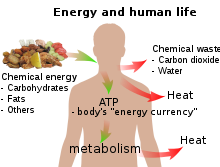
All living creatures rely on an external source of energy to be able to grow and reproduce – radiant energy from the Sun in the case of green plants and chemical energy (in some form) in the case of animals. The daily 1500–2000 Calories (6–8 MJ) recommended for a human adult are taken as food molecules, mostly carbohydrates and fats, of which glucose (C6H12O6) and stearin (C57H110O6) are convenient examples. The food molecules are oxidized to carbon dioxide and water in the mitochondria
and some of the energy is used to convert ADP into ATP:
ADP + HPO42− → ATP + H2O
The rest of the chemical energy of the carbohydrate or fat are converted into heat: the ATP is used as a sort of "energy currency", and some of the chemical energy it contains is used for other metabolism when ATP reacts with OH groups and eventually splits into ADP and phosphate (at each stage of a metabolic pathway, some chemical energy is converted into heat). Only a tiny fraction of the original chemical energy is used for work:[note 1]
gain in kinetic energy of a sprinter during a 100 m race: 4 kJ
gain in gravitational potential energy of a 150 kg weight lifted through 2 metres: 3 kJ
Daily food intake of a normal adult: 6–8 MJ
It would appear that living organisms are remarkably inefficient (in the physical sense) in their use of the energy they receive (chemical or radiant energy); most machines manage higher efficiencies. In growing organisms the energy that is converted to heat serves a vital purpose, as it allows the organism tissue to be highly ordered with regard to the molecules it is built from. The second law of thermodynamics states that energy (and matter) tends to become more evenly spread out across the universe: to concentrate energy (or matter) in one specific place, it is necessary to spread out a greater amount of energy (as heat) across the remainder of the universe ("the surroundings").[note 2] Simpler organisms can achieve higher energy efficiencies than more complex ones, but the complex organisms can occupy ecological niches that are not available to their simpler brethren. The conversion of a portion of the chemical energy to heat at each step in a metabolic pathway is the physical reason behind the pyramid of biomass observed in ecology. As an example, to take just the first step in the food chain: of the estimated 124.7 Pg/a of carbon that is fixed by photosynthesis, 64.3 Pg/a (52%) are used for the metabolism of green plants,[8] i.e. reconverted into carbon dioxide and heat.
Sunlight is the main input to Earth's energy budget which accounts for its temperature and climate stability. Sunlight may be stored as gravitational potential energy after it strikes the Earth, as (for example when) water evaporates from oceans and is deposited upon mountains (where, after being released at a hydroelectric dam, it can be used to drive turbines or generators to produce electricity). Sunlight also drives most weather phenomena, save a few exceptions, like those generated by volcanic events for example. An example of a solar-mediated weather event is a hurricane, which occurs when large unstable areas of warm ocean, heated over months, suddenly give up some of their thermal energy to power a few days of violent air movement.
In a slower process, radioactive decay of atoms in the core of the Earth releases heat. This thermal energy drives plate tectonics and may lift mountains, via orogenesis. This slow lifting represents a kind of gravitational potential energy storage of the thermal energy, which may later be transformed into active kinetic energy during landslides, after a triggering event. Earthquakes also release stored elastic potential energy in rocks, a store that has been produced ultimately from the same radioactive heat sources. Thus, according to present understanding, familiar events such as landslides and earthquakes release energy that has been stored as potential energy in the Earth's gravitational field or elastic strain (mechanical potential energy) in rocks. Prior to this, they represent release of energy that has been stored in heavy atoms since the collapse of long-destroyed supernova stars (which created these atoms).
Cosmology
In cosmology and astronomy the phenomena of stars, nova, supernova, quasars and gamma-ray bursts are the universe's highest-output energy transformations of matter. All stellar phenomena (including solar activity) are driven by various kinds of energy transformations. Energy in such transformations is either from gravitational collapse of matter (usually molecular hydrogen) into various classes of astronomical objects (stars, black holes, etc.), or from nuclear fusion (of lighter elements, primarily hydrogen). The nuclear fusion of hydrogen in the Sun also releases another store of potential energy which was created at the time of the Big Bang. At that time, according to theory, space expanded and the universe cooled too rapidly for hydrogen to completely fuse into heavier elements. This meant that hydrogen represents a store of potential energy that can be released by fusion. Such a fusion process is triggered by heat and pressure generated from gravitational collapse of hydrogen clouds when they produce stars, and some of the fusion energy is then transformed into sunlight.
In quantum mechanics, energy is defined in terms of the energy operator (Hamiltonian) as a time derivative of the wave function. The Schrödinger equation equates the energy operator to the full energy of a particle or a system. Its results can be considered as a definition of measurement of energy in quantum mechanics. The Schrödinger equation describes the space- and time-dependence of a slowly changing (non-relativistic) wave function of quantum systems. The solution of this equation for a bound system is discrete (a set of permitted states, each characterized by an energy level) which results in the concept of quanta. In the solution of the Schrödinger equation for any oscillator (vibrator) and for electromagnetic waves in a vacuum, the resulting energy states are related to the frequency by Planck's relation: (where is the Planck constant and the frequency). In the case of an electromagnetic wave these energy states are called quanta of light or photons.
Relativity
When calculating kinetic energy (work to accelerate a massive body from zero speed to some finite speed) relativistically – using Lorentz transformations instead of Newtonian mechanics – Einstein discovered an unexpected by-product of these calculations to be an energy term which does not vanish at zero speed. He called it rest energy: energy which every massive body must possess even when being at rest. The amount of energy is directly proportional to the mass of the body:
For example, consider electron–positron annihilation, in which the rest energy of these two individual particles (equivalent to their rest mass) is converted to the radiant energy of the photons produced in the process. In this system the matter and antimatter (electrons and positrons) are destroyed and changed to non-matter (the photons). However, the total mass and total energy do not change during this interaction. The photons each have no rest mass but nonetheless have radiant energy which exhibits the same inertia as did the two original particles. This is a reversible process – the inverse process is called pair creation – in which the rest mass of particles is created from the radiant energy of two (or more) annihilating photons.
In general relativity, the stress–energy tensor serves as the source term for the gravitational field, in rough analogy to the way mass serves as the source term in the non-relativistic Newtonian approximation.[10]
Energy and mass are manifestations of one and the same underlying physical property of a system. This property is responsible for the inertia and strength of gravitational interaction of the system ("mass manifestations"), and is also responsible for the potential ability of the system to perform work or heating ("energy manifestations"), subject to the limitations of other physical laws.
Examples of energy transformation include generating electric energy from heat energy via a steam turbine, or lifting an object against gravity using electrical energy driving a crane motor. Lifting against gravity performs mechanical work on the object and stores gravitational potential energy in the object. If the object falls to the ground, gravity does mechanical work on the object which transforms the potential energy in the gravitational field to the kinetic energy released as heat on impact with the ground. The Sun transforms nuclear potential energy to other forms of energy; its total mass does not decrease due to that itself (since it still contains the same total energy even in different forms) but its mass does decrease when the energy escapes out to its surroundings, largely as radiant energy.
There are strict limits to how efficiently heat can be converted into work in a cyclic process, e.g. in a heat engine, as described by Carnot's theorem and the second law of thermodynamics. However, some energy transformations can be quite efficient. The direction of transformations in energy (what kind of energy is transformed to what other kind) is often determined by entropy (equal energy spread among all available degrees of freedom) considerations. In practice all energy transformations are permitted on a small scale, but certain larger transformations are not permitted because it is statistically unlikely that energy or matter will randomly move into more concentrated forms or smaller spaces.
Energy transformations in the universe over time are characterized by various kinds of potential energy, that has been available since the Big Bang, being "released" (transformed to more active types of energy such as kinetic or radiant energy) when a triggering mechanism is available. Familiar examples of such processes include nucleosynthesis, a process ultimately using the gravitational potential energy released from the gravitational collapse of supernovae to "store" energy in the creation of heavy isotopes (such as uranium and thorium), and nuclear decay, a process in which energy is released that was originally stored in these heavy elements, before they were incorporated into the Solar System and the Earth. This energy is triggered and released in nuclear fission bombs or in civil nuclear power generation. Similarly, in the case of a chemical explosion, chemical potential energy is transformed to kinetic and thermal energy in a very short time.
Yet another example is that of a pendulum. At its highest points the kinetic energy is zero and the gravitational potential energy is at its maximum. At its lowest point the kinetic energy is at its maximum and is equal to the decrease in potential energy. If one (unrealistically) assumes that there is no friction or other losses, the conversion of energy between these processes would be perfect, and the pendulum would continue swinging forever.
Energy is also transferred from potential energy () to kinetic energy () and then back to potential energy constantly. This is referred to as conservation of energy. In this isolated system, energy cannot be created or destroyed; therefore, the initial energy and the final energy will be equal to each other. This can be demonstrated by the following:
(4)
The equation can then be simplified further since (mass times acceleration due to gravity times the height) and (half mass times velocity squared). Then the total amount of energy can be found by adding .
Conservation of energy and mass in transformation
Energy gives rise to weight when it is trapped in a system with zero momentum, where it can be weighed. It is also equivalent to mass, and this mass is always associated with it. Mass is also equivalent to a certain amount of energy, and likewise always appears associated with it, as described in mass–energy equivalence. The formula E = mc², derived by Albert Einstein (1905) quantifies the relationship between relativistic mass and energy within the concept of special relativity. In different theoretical frameworks, similar formulas were derived by J.J. Thomson (1881), Henri Poincaré (1900), Friedrich Hasenöhrl (1904) and others (see Mass–energy equivalence#History for further information).
Part of the rest energy (equivalent to rest mass) of matter may be converted to other forms of energy (still exhibiting mass), but neither energy nor mass can be destroyed; rather, both remain constant during any process. However, since is extremely large relative to ordinary human scales, the conversion of an everyday amount of rest mass (for example, 1 kg) from rest energy to other forms of energy (such as kinetic energy, thermal energy, or the radiant energy carried by light and other radiation) can liberate tremendous amounts of energy (~ joules = 21 megatons of TNT), as can be seen in nuclear reactors and nuclear weapons. Conversely, the mass equivalent of an everyday amount energy is minuscule, which is why a loss of energy (loss of mass) from most systems is difficult to measure on a weighing scale, unless the energy loss is very large. Examples of large transformations between rest energy (of matter) and other forms of energy (e.g., kinetic energy into particles with rest mass) are found in nuclear physics and particle physics. Often, however, the complete conversion of matter (such as atoms) to non-matter (such as photons) is forbidden by conservation laws.
Reversible and non-reversible transformations
Thermodynamics divides energy transformation into two kinds: reversible processes and irreversible processes. An irreversible process is one in which energy is dissipated (spread) into empty energy states available in a volume, from which it cannot be recovered into more concentrated forms (fewer quantum states), without degradation of even more energy. A reversible process is one in which this sort of dissipation does not happen. For example, conversion of energy from one type of potential field to another is reversible, as in the pendulum system described above. In processes where heat is generated, quantum states of lower energy, present as possible excitations in fields between atoms, act as a reservoir for part of the energy, from which it cannot be recovered, in order to be converted with 100% efficiency into other forms of energy. In this case, the energy must partly stay as thermal energy and cannot be completely recovered as usable energy, except at the price of an increase in some other kind of heat-like increase in disorder in quantum states, in the universe (such as an expansion of matter, or a randomization in a crystal).
As the universe evolves with time, more and more of its energy becomes trapped in irreversible states (i.e., as heat or as other kinds of increases in disorder). This has led to the hypothesis of the inevitable thermodynamic heat death of the universe. In this heat death the energy of the universe does not change, but the fraction of energy which is available to do work through a heat engine, or be transformed to other usable forms of energy (through the use of generators attached to heat engines), continues to decrease.
It is the common understanding of natural environment that underlies environmentalism — a broad political, social, and philosophical movement that advocates various actions and policies in the interest of protecting what nature remains in the natural environment, or restoring or expanding the role of nature in this environment. While true wilderness is increasingly rare, wild nature (e.g., unmanaged forests, uncultivated grasslands, wildlife, wildflowers) can be found in many locations previously inhabited by humans.
Halting human-induced global warming, which represents pollution, a threat to biodiversity, and a threat to human populations.
Shifting from fossil fuels to renewable energy in electricity, heating and cooling, and transportation, which addresses pollution, global warming, and sustainability. This may include public transportation and distributed generation, which have benefits for traffic congestion and electric reliability.
The fact that energy can be neither created nor destroyed is called the law of conservation of energy. In the form of the first law of thermodynamics, this states that a closed system's energy is constant unless energy is transferred in or out as work or heat, and that no energy is lost in transfer. The total inflow of energy into a system must equal the total outflow of energy from the system, plus the change in the energy contained within the system. Whenever one measures (or calculates) the total energy of a system of particles whose interactions do not depend explicitly on time, it is found that the total energy of the system always remains constant.[11]
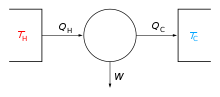
While heat can always be fully converted into work in a reversible isothermal expansion of an ideal gas, for cyclic processes of practical interest in heat engines the second law of thermodynamics states that the system doing work always loses some energy as waste heat. This creates a limit to the amount of heat energy that can do work in a cyclic process, a limit called the available energy. Mechanical and other forms of energy can be transformed in the other direction into thermal energy without such limitations.[12] The total energy of a system can be calculated by adding up all forms of energy in the system.
There is a fact, or if you wish, a law, governing all natural phenomena that are known to date. There is no known exception to this law – it is exact so far as we know. The law is called the conservation of energy. It states that there is a certain quantity, which we call energy, that does not change in manifold changes which nature undergoes. That is a most abstract idea, because it is a mathematical principle; it says that there is a numerical quantity which does not change when something happens. It is not a description of a mechanism, or anything concrete; it is just a strange fact that we can calculate some number and when we finish watching nature go through her tricks and calculate the number again, it is the same.
Most kinds of energy (with gravitational energy being a notable exception)[14] are subject to strict local conservation laws as well. In this case, energy can only be exchanged between adjacent regions of space, and all observers agree as to the volumetric density of energy in any given space. There is also a global law of conservation of energy, stating that the total energy of the universe cannot change; this is a corollary of the local law, but not vice versa.[12][13]
This law is a fundamental principle of physics. As shown rigorously by Noether's theorem, the conservation of energy is a mathematical consequence of translational symmetry of time,[15] a property of most phenomena below the cosmic scale that makes them independent of their locations on the time coordinate. Put differently, yesterday, today, and tomorrow are physically indistinguishable. This is because energy is the quantity which is canonical conjugate to time. This mathematical entanglement of energy and time also results in the uncertainty principle – it is impossible to define the exact amount of energy during any definite time interval (though this is practically significant only for very short time intervals). The uncertainty principle should not be confused with energy conservation – rather it provides mathematical limits to which energy can in principle be defined and measured.
Each of the basic forces of nature is associated with a different type of potential energy, and all types of potential energy (like all other types of energy) appear as system mass, whenever present. For example, a compressed spring will be slightly more massive than before it was compressed. Likewise, whenever energy is transferred between systems by any mechanism, an associated mass is transferred with it.
which is similar in form to the Heisenberg Uncertainty Principle (but not really mathematically equivalent thereto, since H and t are not dynamically conjugate variables, neither in classical nor in quantum mechanics).
Energy transfer can be considered for the special case of systems which are closed to transfers of matter. The portion of the energy which is transferred by conservative forces over a distance is measured as the work the source system does on the receiving system. The portion of the energy which does not do work during the transfer is called heat.[note 3] Energy can be transferred between systems in a variety of ways. Examples include the transmission of electromagnetic energy via photons, physical collisions which transfer kinetic energy,[note 4]tidal interactions,[16] and the conductive transfer of thermal energy.
Energy is strictly conserved and is also locally conserved wherever it can be defined. In thermodynamics, for closed systems, the process of energy transfer is described by the first law:[note 5]
(1)
where is the amount of energy transferred, represents the work done on or by the system, and represents the heat flow into or out of the system. As a simplification, the heat term, , can sometimes be ignored, especially for fast processes involving gases, which are poor conductors of heat, or when the thermal efficiency of the transfer is high. For such adiabatic processes,
(2)
This simplified equation is the one used to define the joule, for example.
Open systems
Beyond the constraints of closed systems, open systems can gain or lose energy in association with matter transfer (this process is illustrated by injection of an air-fuel mixture into a car engine, a system which gains in energy thereby, without addition of either work or heat). Denoting this energy by , one may write
(3)
Thermodynamics
Internal energy
Internal energy is the sum of all microscopic forms of energy of a system. It is the energy needed to create the system. It is related to the potential energy, e.g., molecular structure, crystal structure, and other geometric aspects, as well as the motion of the particles, in form of kinetic energy. Thermodynamics is chiefly concerned with changes in internal energy and not its absolute value, which is impossible to determine with thermodynamics alone.[17]
First law of thermodynamics
The first law of thermodynamics asserts that the total energy of a system and its surroundings (but not necessarily thermodynamic free energy) is always conserved[18] and that heat flow is a form of energy transfer. For homogeneous systems, with a well-defined temperature and pressure, a commonly used corollary of the first law is that, for a system subject only to pressure forces and heat transfer (e.g., a cylinder-full of gas) without chemical changes, the differential change in the internal energy of the system (with a gain in energy signified by a positive quantity) is given as
,
where the first term on the right is the heat transferred into the system, expressed in terms of temperatureT and entropyS (in which entropy increases and its change dS is positive when heat is added to the system), and the last term on the right hand side is identified as work done on the system, where pressure is P and volume V (the negative sign results since compression of the system requires work to be done on it and so the volume change, dV, is negative when work is done on the system).
This equation is highly specific, ignoring all chemical, electrical, nuclear, and gravitational forces, effects such as advection of any form of energy other than heat and PV-work. The general formulation of the first law (i.e., conservation of energy) is valid even in situations in which the system is not homogeneous. For these cases the change in internal energy of a closed system is expressed in a general form by
where is the heat supplied to the system and is the work applied to the system.
Equipartition of energy
The energy of a mechanical harmonic oscillator (a mass on a spring) is alternately kinetic and potential energy. At two points in the oscillation cycle it is entirely kinetic, and at two points it is entirely potential. Over a whole cycle, or over many cycles, average energy is equally split between kinetic and potential. This is an example of the equipartition principle: the total energy of a system with many degrees of freedom is equally split among all available degrees of freedom, on average.
This principle is vitally important to understanding the behavior of a quantity closely related to energy, called entropy. Entropy is a measure of evenness of a distribution of energy between parts of a system. When an isolated system is given more degrees of freedom (i.e., given new available energy states that are the same as existing states), then total energy spreads over all available degrees equally without distinction between "new" and "old" degrees. This mathematical result is part of the second law of thermodynamics. The second law of thermodynamics is simple only for systems which are near or in a physical equilibrium state. For non-equilibrium systems, the laws governing the systems' behavior are still debatable. One of the guiding principles for these systems is the principle of maximum entropy production.[19][20] It states that nonequilibrium systems behave in such a way as to maximize their entropy production.
References
^Johnson, D. L.; Ambrose, S. H.; Bassett, T. J.; Bowen, M. L.; Crummey, D. E.; Isaacson, J. S.; Johnson, D. N.; Lamb, P.; Saul, M.; Winter-Nelson, A. E. (1997). "Meanings of Environmental Terms". Journal of Environmental Quality. 26 (3): 581–589. doi:10.2134/jeq1997.00472425002600030002x.
^Harper, Douglas. "Energy". Online Etymology Dictionary. Archived from the original on October 11, 2007. Retrieved May 1, 2007.
^Smith, Crosbie (1998). The Science of Energy – a Cultural History of Energy Physics in Victorian Britain. The University of Chicago Press. ISBN978-0-226-76420-7.
^Lofts, G; O'Keeffe D; et al. (2004). "11 – Mechanical Interactions". Jacaranda Physics 1 (2 ed.). Milton, Queensland, Australia: John Wiley & Sons Australia Ltd. p. 286. ISBN978-0-7016-3777-4.
^The Hamiltonian MIT OpenCourseWare website 18.013A Chapter 16.3 Accessed February 2007









Comments
Post a Comment